

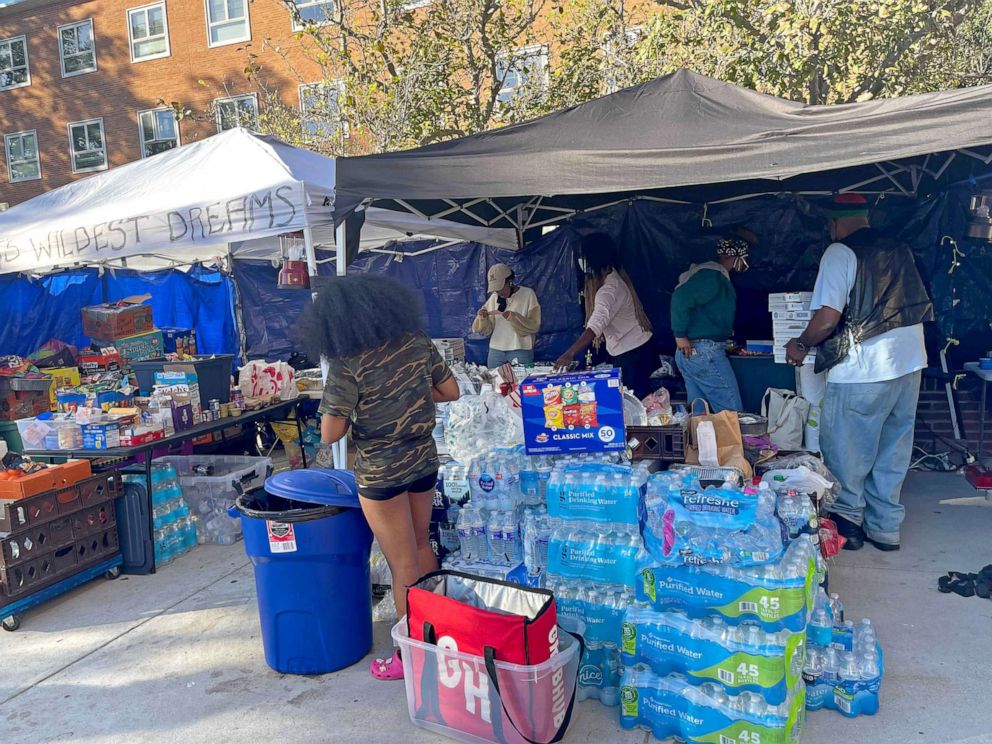
Protesters say they would rather sleep outside than live in the college dorms.
Dozens of Howard University students are sleeping outdoors in a tent encampment on campus grounds to protest what they describe as “poor” and “unlivable” conditions in the college dormitories.
Students told ABC News that portions of the university living quarters have mold and insect and rodent infestations, as well as leaky ceilings and flooding — all of which they say put their health at risk.
Lamiya Murray, an 18-year-old freshman currently living in one of the tents, believes the mold that she said she spotted in her dorm room was responsible for a respiratory infection she battled earlier this year.
“I’m not going to say that I expect a lot more, I expect the bare minimum. I expect decent housing,” Murray told ABC News. “I expect to be in a space where I will feel safe and secure, but the dorms became a health hazard. I was waking up every morning with a cough that I didn’t go to sleep with the night before, and struggling to breathe at night.”
Murray said her reports to campus maintenance have often gone unresolved.
Since Oct. 12, Murray and other student demonstrators have taken over the Blackburn University Center, a student hub and cafeteria located in the central yard of the campus. Organizers said they are not allowing administrators inside the Blackburn building.
One day after the protest began, on Oct. 13, the Howard University Division of Student Affairs issued a warning to protesters occupying the Blackburn University Center, citing the demonstrators for multiple violations of the university’s student code of conduct.
“You will proceed through a student conduct hearing and face consequences up to and including expulsion from the University. The judicial process will be conducted within the procedures of the Student Code of Conduct,” Cynthia Evers, vice president for student affairs, wrote in an email to students, obtained by ABC News.
“We take great pride in Howard students leading the nation in public and private fights for justice and equality in all corners of the nation and, in fact, the world,” the email continued. “However, there is a marked delineation between historic protests and what we witnessed yesterday [Oct. 12] . The University looks to fully preserve the integrity and authenticity of students’ constitutionally guaranteed rights of free speech and assembly while protecting against the weaponization of these rights as false representations of the Howard student experience at large.”
Outside the building, a banner draped across the sidewalk reads: “Enough is enough.” A number of students told ABC News they would rather sleep outside than in their dorm rooms.
Fellow student protesters took turns guarding the door of the center, where some demonstrators inside could be seen through the window resting in sleeping bags, studying or eating food donated by alumni and local civil rights groups who visited them in support of their cause.
“All of our Blackburn family is allowed in and out of the building,” Murray said, telling ABC News they are not allowing administrators or press into the building. “It’s the outsiders that we’re worried about. We’re trying to keep students safe and keep everybody in an atmosphere where they feel comfortable to express the things that are happening on campus.”
A private group message board shared among students and reviewed by ABC News posted photos they say show hazardous dorm environments.
The sit-in, organized by the Young Democratic Socialists of America and The Live Movement, has gone viral under the hashtag #BlackburnTakeover. The tweets have garnered attention from celebrities, including artists from rapper Gucci Mane’s 1017 record label, who pulled out of performing at Howard University’s homecoming this weekend. Students at other historically Black colleges and universities have also shared videos and pictures on social media of alleged low-quality living conditions at their schools.
“There are students whose belongings were lost, or have been destroyed by floods, by mold, by all types of insufficient living conditions and it’s hurtful. Even if you’re not the person who is experiencing that, just listening and taking it in, with us being a community, it’s very hurtful to hear,” said Deja Redding, a Howard University graduate student and director of The Live Movement, a campus-based organization focused on advocating for racial equity in education.
